
Snack at Your Own Risk: FDA’s Shutdown Hangover
Yasmeen Kabaria
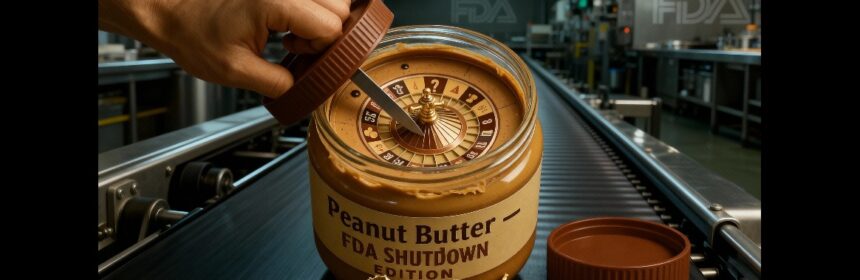
The next time you twist open a jar of peanut butter, imagine this: somewhere in a dimly lit factory, conveyor belts are still running, but the inspectors who should be checking for salmonella are gone. The government has shut down, the FDA’s lights are half off, and the food on your shelf is suddenly a game of chance – every bite, a roll of the microbial dice. It sounds terrifying, right? The kind of bureaucratic horror story that could make you eye your lunch suspiciously.
But here’s the twist: that nightmare isn’t quite the reality. Despite the headlines, roughly 86% of FDA employees are still working through the shutdown, keeping critical safety operations running. In fact, this isn’t the agency’s first dance with dysfunction. The FDA has weathered many shutdowns before, adapting each time to make sure America’s food doesn’t actually become a public-health thriller. And here’s the part that almost no one tells you: the FDA doesn’t actually run on the same funding lifeline as most government agencies. When a shutdown hits, the image we picture – dark hallways, empty offices, and locked doors – doesn’t fully apply. While “government shutdown” might sound like every food inspector packs up their bag and every drug review screeches to a halt, the reality is far stranger and a bit more reassuring.
Around 86% of the FDA’s workforce is still clocking in, and it’s not because the agency is immune to politics. It’s because the FDA has something like a financial side hustle: user fees. These are payments that companies make directly to the agency when they want their products reviewed – think pharmaceutical companies submitting new drugs for approval or medical device manufacturers seeking clearance to sell their latest innovation. Those payments don’t come from taxpayers; they come from the private sector, often paid well in advance.
So even when Congress can’t agree on a budget, those industry-funded pools of money keep certain parts of the FDA humming. The agency can still review drug applications, monitor vaccine safety, track adverse events, and even oversee urgent recalls. The system isn’t flawless – there’s a ticking clock, since once that carryover funding runs out, so does the work – but it’s surprisingly resilient.
It’s an odd paradox, really: the same shutdown that silences national parks, pauses passport renewals, and sends federal workers home without pay leaves much of the FDA still functioning, powered not by Washington’s gridlocked politics but by the industries it regulates. It’s almost dystopian when you think about it – a public safety agency meant to protect consumers kept alive by the very companies it’s supposed to police. Yet that uneasy balance is exactly what allows your local pharmacy to stay stocked and your hospital’s supply chain to keep moving, even when the rest of the government grinds to a halt.
Still, for all its resilience, even the FDA isn’t untouchable when Washington stalls. Its backup funds and user fees keep it alive – but not untouched. During every funding lapse, the agency has had to decide which parts of public health can afford to wait.
That nearly happened again in March 2024, when Congress faced two shutdown deadlines: March 1 for the FDA and VA, and March 8 for Health and Human Services. If the clock had run out, almost one-fifth of FDA staff – about 3,300 employees – would have been furloughed, leaving just 64% working under alternate funding and 17% retained for emergency duties.
History shows how that plays out. In the 2018–2019 shutdown, about 40% of the agency went dark. Websites stopped updating, emails went unanswered, and new drug applications froze mid-process. Because the FDA can’t accept new user fees during a shutdown, companies that hadn’t already paid couldn’t even submit their products for review.
Even the threat of shutdowns in 2023 and 2024 caused slowdowns in FDA communication, especially as more agency work moved online. Drug approvals funded by existing user fees continued, but everything else – guidance updates, routine inspections, general correspondence – lagged behind. The FDA doesn’t collapse when the government stops; it just flickers. The lights stay on, but dimmer. Each shutdown becomes another stress test for an agency forced to keep protecting public health on a flickering power supply.
When the FDA Slows, the Drug Industry Holds Its Breath
Every minute the FDA stalls, someone in the pharmaceutical world loses more than just patience. A delayed email might hold up a clinical trial. A postponed meeting could push back a drug launch by months. In a business where patents tick like clocks and investors think in quarters, uncertainty isn’t just inconvenient – it’s expensive.
During a shutdown, the FDA can’t accept new user fees, which means no new drug applications can even enter the queue. Companies that already paid can keep moving forward, but everyone else is forced into limbo. For emerging biotech startups – many running on tight funding windows – those weeks can mean losing investor confidence or even shutting down before their product ever reaches testing.
Even ongoing reviews slow to a crawl. Reduced staffing means fewer reviewers, fewer communications, and longer waits for feedback. That delay doesn’t just cost money – it can delay patient access to potentially life-saving treatments. In the 2018–2019 shutdown, for instance, drugmakers saw those stalled reviews ripple through their timelines for months afterward, long after normal operations resumed.
And the effects don’t stop with big pharma. Academic labs, smaller biotech firms, and hospitals conducting clinical research all rely on FDA oversight and approvals. When the agency slows down, innovation stalls, and the entire pipeline – from lab bench to pharmacy shelf – clogs up.
Shutdowns have become a recurring experiment in just how self-sufficient the FDA can be. Each time, industry fees and emergency funding keep the wheels turning. But if the agency can operate indefinitely on corporate funding, what happens to public trust? When regulation depends on the regulated, the line between watchdog and partner starts to blur – and that’s when the real danger creeps in.
Not in your jar of peanut butter or your frozen dinner, but in the quiet assumption that someone else is still watching. Because if no one’s really minding the kitchen, how long before something starts to spoil?
Copy editor: Evelyn Lynch
Photography source: Sora (OpenAI)